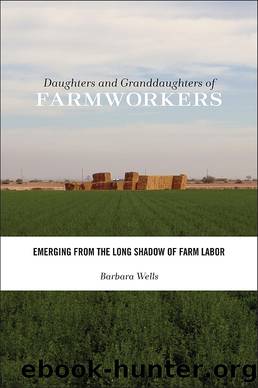
Daughters and Granddaughters of Farmworkers by Barbara Wells
Author:Barbara Wells [Wells, Barbara]
Language: eng
Format: epub
Tags: Social Science, Ethnic Studies, American, Hispanic American Studies, Agriculture & Food, Emigration & Immigration
ISBN: 9780813562865
Google: io_0AgAAQBAJ
Publisher: Rutgers University Press
Published: 2013-11-15T04:24:46+00:00
Chapter 6
Surviving Now and Building a Better Life for Later
This chapter considers the microlevel strategies used by the families represented in this research as they respond to macrolevel constraints and strive to achieve personal and family goals. The chapter has two major concerns. The first is to examine how these daughters and granddaughters of farmworkers (and their partners, if present) manage to provide the basic necessities of life for their families in a context in which it is difficult to do so. The second is to analyze what women say about upward mobility and the obstacles they encounter to achieving it. These subjects connect to two larger public issues: the impact of the structure of California agriculture on farm-dependent communities, and prospects for upward mobility among second- and third-generation Mexican Americans in the United States.
Rural areas present specific barriers to self-sufficiency and upward mobility. While rural areas have many problems in common, particular patterns of difficulties are associated with the type of economic activity that dominates the locale. As Tickamyer and her colleagues summarize succinctly, âAmong these problems are severe deficits in resources, employment opportunities, infrastructure, social and human capital, leadership, and political influence at more central levels of governmentâ (2002, 236). What is especially relevant for this analysis is that Imperial County is a farming-dependent county and the structure of its agricultural production is labor-intensive, requiring a large pool of flexible, low-wage labor.
A perhaps unforeseen consequence of the labor-intensive model of agriculture is the significant costs it creates for rural California communities (Taylor, Martin, and Fix 1997, 37). Because workers receive poverty-level wages, they are eligible for public benefits in their local communities. In paying low wages, growers pass along some of the costs of supporting these workers to federal, state, and county governments that partially underwrite, for example, the cost of their food and housing. The rural communities that bear these costs are arguably those least able to do so.
Another angle on the public costs associated with the current structure of farm labor comes into view when the hazards associated with the work are examined. Disability prematurely shortens the work lives of many farmworkers, who require public assistance at several junctures. First, Supplemental Security Income (SSI) is available to disabled farmworkers. Then, if the disabled worker needs assistance to remain at home, home health care is provided through the countyâs In-Home Supportive Services (IHSS) program. Frequently, the care providers are women with children, and because home health aides receive only minimum wage, caregivers qualify for government subsidized child care. The concerns of disabled farmworkers came into clear view in this research because many women had disabled farmworker parents and some women were home health aides providing assistance to disabled farmworkers.
My intent here is not to argue that communities should not be responsible for providing assistance for all needy members of the community. Rather, it is to point out that when agricultural interests contend that the current system is the best way to produce the inexpensive food that Americans
Download
This site does not store any files on its server. We only index and link to content provided by other sites. Please contact the content providers to delete copyright contents if any and email us, we'll remove relevant links or contents immediately.
| Anthropology | Archaeology |
| Philosophy | Politics & Government |
| Social Sciences | Sociology |
| Women's Studies |
Cecilia; Or, Memoirs of an Heiress — Volume 1 by Fanny Burney(32558)
The Great Music City by Andrea Baker(32018)
Cecilia; Or, Memoirs of an Heiress — Volume 2 by Fanny Burney(31956)
Cecilia; Or, Memoirs of an Heiress — Volume 3 by Fanny Burney(31941)
We're Going to Need More Wine by Gabrielle Union(19046)
All the Missing Girls by Megan Miranda(16023)
Pimp by Iceberg Slim(14506)
For the Love of Europe by Rick Steves(14121)
Bombshells: Glamour Girls of a Lifetime by Sullivan Steve(14073)
Talking to Strangers by Malcolm Gladwell(13370)
Norse Mythology by Gaiman Neil(13363)
Fifty Shades Freed by E L James(13239)
Mindhunter: Inside the FBI's Elite Serial Crime Unit by John E. Douglas & Mark Olshaker(9339)
Crazy Rich Asians by Kevin Kwan(9290)
The Lost Art of Listening by Michael P. Nichols(7506)
Enlightenment Now: The Case for Reason, Science, Humanism, and Progress by Steven Pinker(7311)
The Four Agreements by Don Miguel Ruiz(6763)
Bad Blood by John Carreyrou(6621)
Weapons of Math Destruction by Cathy O'Neil(6279)
